
June 2026
One of the most startling aspects of death for me has been other people's pre-determined narratives. At the risk of going off on a tangent, I believed that pre-determined narratives, though part of the human condition, have become more pushy and more limited in our modern world due to things like social media (which justifies them and blocks critical thought).
When the pre-determined narratives are about people's own lives, I don't mind so much. But I've been startled by the number of people who have approached me, not with experiences to share or with questions to ask or with simple social courtesies...but with entire fables about what I'm thinking and feeling and doing: an (atypical) hospice nurse who told me, on the same day I learned of my mom's death, that I needed to "stop keeping busy" and "assimilate" the experience; a woman at my mother's funeral who told me I will now have a permanent "hole" in my heart right after I commented that my parents had good lives and I felt no regrets; family members who assumed that both parents being dead, I would leave a state I've lived in for 30 years.

Being faced with other people's versions of my state of mind makes me miss my parents. My mother was more likely than my father to invent a pre-determined narrative, but she was quite blatant with her storytelling. In the moment--after she presented her version of my life and before she gave me non-applicable advice--she would listen to whatever I had to say without resorting to "you're only saying that because...you don't appreciate all the stuff I just made up about you..." Ultimately, she wanted to talk, even argue, not orate.
My father was one of the few people in my life who actually believed the things I said to him about myself without question.
I write below about my mom's death--including how I actually feel:
My mother died May 21, 2026 in the early morning. She suffered from dementia for a number of years, possibly as much as 15. However, with a high vocabulary, multiple interests, and continual engagement with people and projects, issues associated with dementia didn't manifest until about 8 or so years ago. She began to wander approximately 5 years ago, right before my parents moved into a tier-assisted living community. For her safety, my mother then had to be moved into memory care.

For about 3-1/2 of her years in memory care, my mother--though positive that her parents were still alive and given to stating that she was on a train or ship--engaged with group activities, where she exhibited many of the traits that she exhibited throughout my childhood and adulthood: curiosity, investment, a little bossiness. She also gained a reputation for being one of the unit's escapees, so when the door alarm sounded, hers was one of the first rooms the aides checked. She was fully capable of making her way downstairs where, I would say, "She'll catch a taxi to the airport and get on a flight to New Zealand before we know it!"
I was only half-joking.
She was a very independent woman and continued to get around the memory care unit--from her room to the activities and back to her room--on her own schedule and through her own volition until the last year or so, when she became confined to a wheelchair and then, as the dementia progressed, lost control over more and more bodily functions. Hospice was (mostly) fantastic; in her last days, she was cared for by the same nurse who cared for my father. Although almost entirely unresponsive in the last week, church and friend and family visitors appeared to calm her. She went peacefully in her sleep.
 |
| Painting by Joyce |
Like many children/women since the beginning of time, I had difficulties with my mother as a mother and pondered, when I reached adulthood, whether a relationship with her was possible. But I built a relationship with her as an adult because she was so interesting. Excluding my personal life (with one exception), I could talk to my mom about anything: gardening, religion, politics, art, history, murder mysteries (a shared interest), Jane Austen, books in general, mythology, science, health, houses, house decorating, clothes, food, movies, her childhood, her siblings, her parents, her pets, etc. etc. etc.

And I could talk to her about my work. My mom was also a teacher--in her case, of art to elementary and high school students (I teach English to community college freshmen). She would share stories, listen to my complaints, ask about my topics for composition and literature. "Teaching" was one keyword that still elicited a non-random response from her through her dementia.
I will miss my mom, just as I miss my dad. Of the social niceties, the most common I've received and the one that bothers me the least is "now she is free of pain and with Hugh." I do have faith in those possibilities (I don't consider have faith in those possibilities to be a failure of belief since I consider I know that for sure to be blasphemous).
I am not suffering from debilitating emotions/any loss of mental health. Other than being tired and occasionally experiencing mono no aware (over a sudden memory), I do not feel especially out of sorts. I have not--any more than my mother ever did--run out of ways to occupy my time (my mother was never bored). I am not struggling to make sense of things.
Frankly, I puzzle over why I would undergo any of the aforementioned negatives (which have been suggested to me as givens by others). One reason I don't feel them is, in part, because of my personality. The other reason is in honor of my mother.
She was an infinitely practical woman (most of the time). Although we clashed over the pre-determined narratives she invented about me, she was always a realist. Right up until the end, she was wholly understanding when I had to leave her because "I have to go to work, Mom. I have to go get things done."
She was also, despite being considerably more extroverted than my father, quite a reserved woman and would not have found anything wrong with my Austen-like response to whatever feelings I have.
Truth is, even today, the day after her funeral, both my parents would say to me, "Okay, so what are you going to do today?"
All for the sake of the doing.
October 2025

The purpose of this post is to talk about what my dad was to me. He wasn't a perfect guy. I never felt an instinct to worship him (though since his death, I've been tempted based on the number of staff members in his assisted living community who spoke to me positively about him: he was never rude; he never made unreasonable demands; he was always upbeat and pleasant...).
When I was younger, I performed with him in plays. On church camping trips, I recited poems with him, including Lewis Carroll's "You are Old, Father William." I played the trumpet in high school because my dad played the trumpet when he was younger. Regarding school, he occasionally helped me with my math homework.
My parents and I both moved (separately) to Maine in 1996. They lived on Peaks Island but came to the mainland for church on Sundays. Every Sunday until COVID lock downs, we ate lunch together, usually sandwiches prepared by my mom.
Eventually, my parents left Peaks Island for a series of retirement homes. I began to accompany my dad to his doctors' appointments as his "scribe." Starting approximately four years ago, after my mother moved into Memory Care, I began to see my dad twice a week: once after I visited my mom and once when I picked him up for church. Every Sunday, I would pull up to the facility and watch a very thin, stooping man with (usually) uncut white wild hair--yet immaculately dressed in a suit with tie and maroon sweater--slowly make his way out of the building to my car.
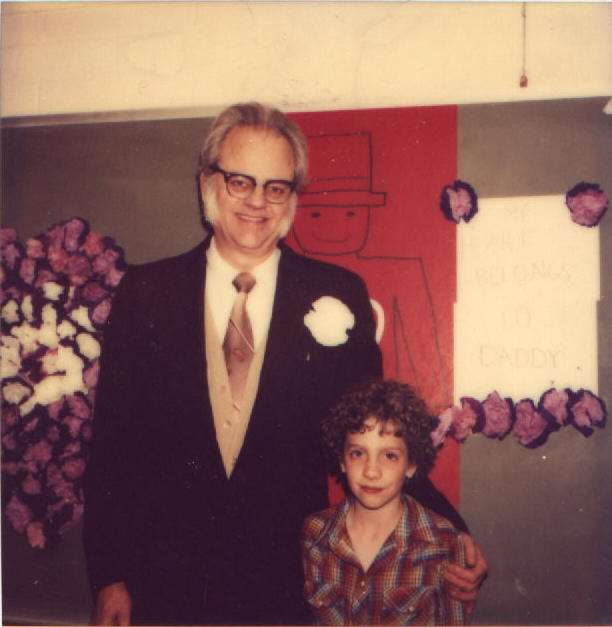 2025 saw a radical change. After a stint in rehab, he did not return to physical church though we continued to attend on Zoom. I also began to eat Sunday breakfasts with him. I would order blueberry pancakes and Eggs Benedict, then split the meals between us. About this time--and to my eternal gratitude--hospice took over much of his care.
In May, it seemed that the final days were close. However, as hospice told me in wonder, "Your parents are a surprise!" My dad kept going. His long-term memory was mostly gone (though occasionally he would remember information I'd passed on to him about my job), but he continued to read books I brought him, to watch the cars and trees outside his windows, to now and again check the news on his home computer, to take whirlpool baths, to spend time with my mom (staff and hospice would arrange for them to sit together), to watch Zoom church, including (marvels of technology!) our old ward in Schenectady, New York, and to treat all visitors with great friendliness.
At the end of every visit, as I was leaving, he would say, "Say, 'Hello' to your cats!"
At some point on this blog, I will comment on my relationship with my mother. It was more complicated than my relationship with my father--and what I got out of the two relationships, in terms of positives, was quite different.
From my father, I got a lack of judgment. It wasn't only that he refrained from lecturing me: telling me what I should do better--pronouncing how much he loved me in the same breath as asking me why I wasn't leading a completely different life--scolding me for not performing certain actions...
 |
He didn't do those things. More importantly, it never occurred to him to do them. And I worked hard to show him equal respect even when I had to make decisions about his care. A belief in agency--the other person as a whole individual--was a common thread between us.
When I made my visits, I was simply Kate, his youngest. I was me; he was Dad. I never had to wonder if he would be happier if I was someone else. Although a romantic and an idealist, he had the touching and remarkable ability to accept what was before him. Life is life.
I will miss him very much.
And, Dad, my cats are doing well.
***
June 2005

My parents are, on paper at least, opposites. My mother is an artist with a B.A. in Art from Brigham Young University and a M.A. in Printmaking from SUNY Albany. She taught for several years before her first child was born. Like everyone in our family, she reads a lot, especially mysteries and currently Forester's Horatio Hornblower series.
She also reads history, and is something of an amateur historian on a few subjects; when I taught seminary for our church, she was my go-to person for The New Testament. My mother read to me up until I was in Junior High, and she probably would have kept going if I hadn't turned into a teenager and persisted in finishing the books we started. These days we share a love of books on tape.
 |
My mom used to invent stories as well, mostly about a troll named Milo. Her considerable artistic talents are more visual (she understands abstract art!), and in the last ten years that creative flair has expressed itself more and more in her flower garden(s).
My father is a scientist with a Ph.D. in nuclear physics. He worked at G.E. Research & Development all his career and was part of the team that recreated the first industrial diamond. He claims not to understand Quantum Mechanics, which is kind of like Shakespeare disclaiming higher education (it may be true, but come on, it's Shakespeare). My clearest childhood memory of my father is of him paraphrasing science articles at the dinner table. Even now, he will pass on tidbits from Greene's Elegant Universe or articles he has read, and he helps me considerably with my sci-fi stories. Despite being the introvert in the relationship, my father has acted in a number of plays and once recited Lewis Carroll's The Song of the White Knight with me playing the part of Alice. Nowadays, he plays the stock market, levels the lawn (and levels the lawn...and levels the lawn). He also has a penchant for history and when I taught seminary, he was my go-to person for Old Testament and Book of Mormon.
So, on paper, my parents would seem to be opposites, complementary opposites, but opposites nonetheless. Extrovert/Introvert. Science/Art. Language/Math. However, these are false dichotomies. My parents operate, as the saying goes, on the same wavelength. One component of that wavelength is their service in the Mormon Church (in which we were all reared). They work in the Boston Temple every week which, for people living in Maine, entails a fair amount of time and money, all volunteered.
 Another component, and the one that brings us back to popular culture, is their commonsense. They are commonsensical. Not given to sentimentality (although a romantic streak runs through the family) but people who have a high level of discernment. There's not any cynicism involved. They just see the world as is and keep going. (Maybe it's a gardening thing.) Which isn't to say my parents, like all of us, don't have their pet peeves, their soap boxes and their sacred cows but they also, to a remarkable degree, try to look at themselves objectively. I'm not saying they always succeed. Does anyone? But the point is, they try.
What this character analysis boils down to is: they did not raise their children to be relativists. Life might all be some mind game, God might be a boiled egg and time might not exist, but if you're an artist and a scientist of my parents' schools of thought, you start from the proposition that something is going on around you, you are collecting and reacting to data. Sure, it could all be in your head, but that's a totally boring approach to life so why bother going there? Start with the proposition that some sort of reality does exist, that we are all experiencing some degree of synchronicity and then accept the hard work of trying to understand it (which hard work should not entail either angsty self-righteous intellectualism or undisciplined "oh nobody knows anything anyway" gloopiness) and, well, life rapidly gets very fun.

Which is what my parents taught me and is what I'd like to thank them for here. Life is great! Life is fun! My parents are kind of like spiritual anti-Augustinians. The body is good! The physical world is a blessing! It's swell to be alive! Isn't it interesting? Isn't it grand? They are Mormons born and bred (and I am deliberately using the "older" term since pioneers thrived in both my parents' ancestries), and their particular attitude towards life is influenced by the progressive positivism implicit in Mormonism: that life matters, that it isn't just some way-station where we hang out and mope until God snatches us home; it isn't simply an experiment where God prods us with a few trials and notes our responses and pats us on the head.
Life is worth living for its own sake because only living life (for its own sake) can prepare you for the next stage. Life should fully engage us. God wants it to. You can't live in heaven if you don’t know how to live on earth. Come Judgment Day, God will hand out as much freedom and experience and love as we can handle. If we can't, if we settle for dry, stale ideologies, if we weigh ourselves down with distrust, anger, guilt and cynicism, that's the kind of heaven we'll settle for.
 So, in a way, the relativists are right, because the heaven you think is possible is the heaven you will get. The point of religion, Mormonism in particular, is to train us not to settle for less. And it starts with our immediate surroundings.
Okay, morphed a bit there into my own opinion, but it all goes back to my parents. I grew up knowing that my parents had a multiplicity of interests that went beyond their family and for that matter, each other. Those interests often dovetail (like the lawn, the dirt, the vegetable garden, the flower garden and the fruit trees: ALL related) in their theological beliefs as well as the arts, but my parents were always individuals in my eyes, which, for a child, can be revelatory if a little frightening. These people, one learns fairly early, are not just here for my benefit. And too, I grew up seeing that, contrary to an attitude I've run into lately, religious observance does not limit a person to a bland-room-with-bland-curtains-and-bland-floor mentality.
Now, my parents have never been into The Top 40. They don't particularly like action movies (Schwarzenegger variety). They detest commercials. They have never, to my knowledge, attended a rock concert. And we grew up without a TV (well, for most of the time). You couldn't have paid my mom to watch soaps. Which isn't to say we didn't go out to see movies (where my father, the most honest man alive, would let us sneak food into the theaters). Still I mostly grew up going to ballet and listening to opera and classical music and seeing Shakespeare. My parents truly enjoy doing those things. But—here's where the commonsense comes into play—it was never "we're seeing this because of how important it is"; rather, "we're seeing this because we like it." They also like Agatha Christie (my mom), Alice in Wonderland (my dad), Peter, Paul & Mary, Garrison Keillor (before he got popular, mostly), chocolate (my mom!), Tolkien, shaggy dog stories (my dad) and so on and so forth.
And the more I study popular culture and listen to academics talk about popular culture, the more I've realized that this liking is the missing component. Academics can read between the lines like nobody's business. They can analyze till the cows come home (it's not that difficult a skill to master). But at some basic level, they don't understand why people really like what they like. So they make up reasons. If they like it themselves, they give themselves Freudian complexes or shake their heads at their own cupidity (I've been brainwashed by the corporate capitalistic conspiracy!).
 It never seems to occur to them that it's fun! That's it's funny! You don't have to believe that watching action movies involves a deliberate suspension of belief to which all parties are privy (the secret compact theory of popular culture); you just have to believe that people like doing it.
So, Mom and Dad, thanks for teaching me that life is fun, that enjoying life is as much a part of religion as praying or reading the scriptures, that the world is a fantastic place that it never harms us to find out more about and especially for loving life and each other.

